Juxtapositions (September 11/Walk/Cancer/Hope)

Walking beside the Hudson River

Intro: Almost ten years ago, in October of 2001, I completed my first Avon walk for breast cancer, twenty miles a day for three days.* It turned out to be life-changing in completely unexpected ways.

Originally we were to walk in early October down from Bear Mountain, beside the Hudson River and across the George Washington Bridge into Manhattan. Closing ceremonies were to be at Bryant Park, near the main public library in New York City. I’d been training for months, and I’d raised the money I needed to walk.

But on a single day, all plans changed–for the walk, for the country, and for me. My little personal concerns merged–in my mind–with huge national issues and the suffering of many.

On the morning of September 11, I left my office to pick up my mail and found my colleagues clustered around a television in the lounge. Two planes had flown into the World Trade Center and both buildings had collapsed. Like everyone else in the country, I watched the videos over and over again until my mind was numb.

Then I went back to my office. Because I couldn’t concentrate, I thought it a good time to check with my doctor about the results of a follow-up mammogram. I found out I needed to see a surgeon.

Before the day was over, plans for the Avon New York Walk for breast cancer were in disarray. No one even knew whether the walk would be held. Perhaps the organizers didn’t know what to do. Certainly New York officials were not prepared to let several thousand people, mostly women, walk over the George Washington Bridge, walk through the streets of Manhattan, and congregate in Bryant Park.

For a few weeks, we walkers sent a flurry of email to the organizers and to each other. Eventually we were told the walk was on, but postponed to the end of October and we wouldn’t be allowed to walk across the bridge into Manhattan. Instead, we would spend the final day walking around Rockland County and have closing ceremonies at a community college. Disappointing, but understandable.

On the weekend of the walk, I was excited about walking but worried about my biopsy, scheduled for the Monday after the walk. I was still reeling from the events of September 11th, and so was everyone else. Almost everyone walking that weekend was a New Yorker, and everyone had a story to tell of a friend or relative touched by the tragedy. Many had been close enough to see the flames and smoke, to breathe in the evil fumes. We told each other stories.

Even I, living upstate, had a story or two. I told of my son who had taken the train into Grand Central Station on 42nd St. arriving minutes before the first attack downtown. He saw the flames above the NYC skyscrapers as he began walking towards his meeting. Cell phone lines were jammed, his meeting surely cancelled. Soon after he returned to the station, it was evacuated. He began the long walk, in business suit and dress shoes, uptown, away from the disaster. Every face he saw was serious and stricken; no one was unaware or unaffected. He heard snatches of news on car radios. He stopped for lunch on 95th St. where he joined stunned New Yorkers. Late that day he reached the 125th station in Harlem and later still, he was able to catch the first train leaving the island of Manhattan to go home.

I told the story of my husband’s son-in-law who had been in the World Trade Center during the first attack on it ten years earlier. He descended dozens of floors in a smokey stairwell, carrying a frail, elderly woman on his back.  He laughs when he tells us that she was complaining because she was uncomfortable.

The story that haunts me, even after all these years, was that told by a young firefighter. He had been told to come late that morning because it was his first day of work.  By the time it was time for him to go in, every other firefighter in that station was dead.

And all the while we were trying to exorcise the pain of September 11th, we also talked about breast cancer–care, treatment, options, people who had survived, people walking for others’ health or memory. Several offered me advice about my own treatment to come.

By the end of October, that year, it was bitterly cold in New York. Temperatures fell at night to the low thirties. Staff went from tent to tent passing out shiny emergency blankets. Between the cold and my weariness, my middle-aged, arthritic body was screaming for Advil. Because I
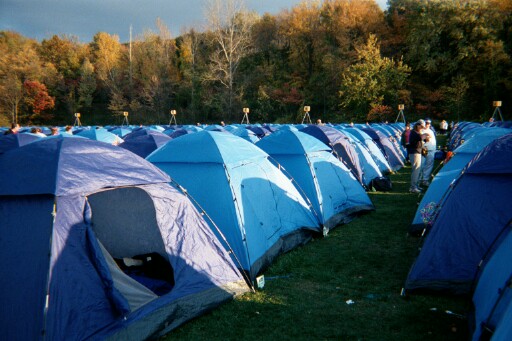
Our row of tents

was scheduled for surgery when I got home, I took no pills, but lay in my sleeping bag thinking cranky thoughts.

Miraculously, our discomfort and our fears for our country and our health only intensified the spirit of triumph on the walk. Even though we might not change a single life or single event, we were trying to express something positive. We were walking. We would support others and we would face troubles with dignity and courage. Our stories mattered.

Here is one. I had met a young woman, in her early thirties, when I was training for the walk. Both her parents had died, her mother of breast cancer. She had cystic fibrosis, and her training was frequently interrupted by hospital stays. She told me that friends and family had warned her that she shouldn’t walk. It was much too hard for her weakened body.

But what else can I do?” she asked. “This is the only life I get to live.”

In the end, she was too sick to walk, and it was I who wrote her mother’s name on the wall honoring the memory of those who had died of breast cancer.

And we walked. Volunteers played music at rest stops, doled out hearty portions at mealtimes, posted funny signs along the way. At rest areas, they passed out Gatorade, bananas, granola bars, Band-Aids, souvenir stickers for our name tags. One young man parked his van along the way each day with his baby son sleeping nearby. He passed out candy and cracked jokes. His wife was one of the walkers.

A bakery near the Tappan Zee Bridge distributed pink cookies in the shape of ribbons to honor an employee who had struggled with cancer. An elementary school band played “When the Saints Come Marching In” as we straggled into their town for lunch. Their hand-made posters were plastered on every pole along our route.

At the end of each day we might have been tired and have blisters, but our legs and lungs and hearts were all still working, one step at a time. And the bright-colored autumn leaves on the trees were stunningly brilliant. The Hudson River was never more beautiful.

My husband met me at the finish line.  He’d been my supporter all along, even walking with me often when I was training. My son and his family, my stepdaughter and her family, my friend and her daughter all met me too.
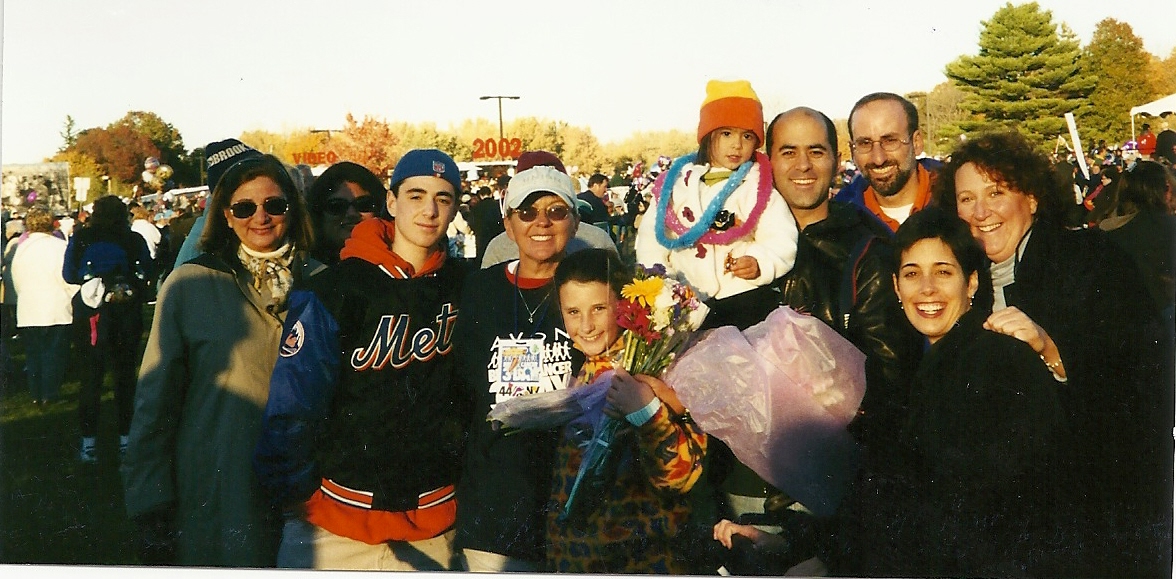
Family meets me at the finish line.

Life seemed impossibly hopeful and achingly meaningful.

So I’ve decided to walk again this coming October provided that my senior-citizen body cooperates. (I’ll have a serious talk with it.) This post is my commitment to register and to put on my sneakers and head for the park.

Why walk, you say?
Because this fall it will be ten years since September 11th, ten years since I walked for the first time, and ten years since I had my brush with early-stage breast cancer. I was luckier than many. My niece Tina, lovely Tina, died of breast cancer, leaving behind a husband and two little girls.
Because I want money spent on research to eliminate the disease so my daughters-in-law, stepdaughters, and granddaughters will never fear the disease.
Because I want to join others trying to be decent, kind, and brave, by putting one step forward and then another.
And because the leaves and the river will be beautiful in October, again, and life worth celebrating.

*******

If you’d like to support me this year when I walk in October, please visit my Avon page at http://info.avonfoundation.org/goto/MargaretFrench.

Just so you know… After my second walk, in 2002, the Avon Foundation parted company with the company that had organized their 3-day walks. Now there are two long walks for breast cancer in the United States: the Susan G. Komen 3 day and the Avon 2 day. 

*

Copyright by Margaret French
Sticks and Stones

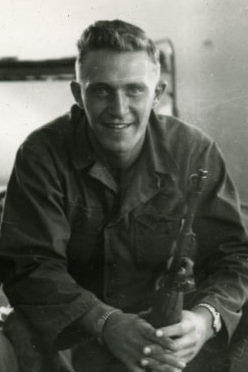
Jay in the army with his rifle.

Intro: I held this post a few days…in Tucson, Obama had made the case for civility far better than I ever could. Still, I like this story, hope you do too.

My husband, Jay, and his brother-in-law Herb were both drafted during the Korean War. In basic training, each was issued an M-1 rifle and a bayonet.

As they tell the story now, both their drill sergeants performed the same ritual. Each would yell out to the men,

What is the spirit of the bayonet?”

And all the recruits would lunge forward, bayonets mounted on their rifles, gutting yet imaginary foes, and yelling the response in unison:

“To kill. To kill.”

Everyone except Herb. He lunged forward with the others, but only mouthed those offensive words, unable and unwilling to utter them out loud, hoping the sergeant wouldn’t notice. The Herb I’ve come to know is unfailingly gentle and kind. No doubt the army was wise, back then, to assign him to a desk job.

It’s the army’s job to train people to use the weapons they’re issued. That can’t be easy. The army must realize that a man’s heart and mind have to be adjusted before he’ll be able to plunge a sharp bayonet into another human being.

So they use the power of words.

Do any of us really believe that “words can never hurt us”? Don’t all of us live with the hurt inflicted by a sharp-tongued relative or friend? Were none of us ever influenced by the words of another, especially when uttered passionately?

Public figures who use violent words and violent imagery absolutely don’t mean for us to shoot political opponents. They want higher ratings or they want our votes.

But I for one will watch other programs; I’ll read other writings; I’ll vote for other people.

*

My husband, Jay, has asked me to add a note to this post. If I’ve described Herb, who wouldn’t utter the words, as gentle, how does that make Jay look–and every other young man who did what the drill sergeant told him to do? Let me assure you that Jay is also a gentle, good man.  That’s why I married him.

*

Copyright by Margaret French

Corn and Watermelon

Intro: I love the fancy traditional meals that we’ve been enjoying over the holidays.  Here’s a story about expectations  related to food.   And just maybe, it’s a longing for summer foods, in this, the coldest month of the year in Saratoga.

Good stuff.

When I was nine, my family moved to Calgary, Alberta. Horse country. Big cattle ranches. Rodeos. In Calgary, you can saunter down the street wearing a cowboy hat and fancy cowboy boots and not feel foolish—even if you happen to be a teacher or a construction worker or a poet.

In Calgary, my father made a new friend, an ex-bronco-riding, calf-roping cowboy named Slim. Dad bought two horses from him, a big feisty buckskin and a gentle bay mare named Talullah, a horse for him and one for me. Why just me, you say? Well, my little brother was a toddler. My older brother came down with polio and couldn’t ride. My sister thought that horses were smelly and disgusting, and my mother didn’t care to ride. So it happened that my father and I rode together, almost every day, for several years. Good years.

Every once in awhile, our horses needed shoes. And he and I would ride on paved streets around the edge of Calgary to the blacksmith’s shop. I loved everything about the shop. The strong warm smell of the horses mixed with the burning smell of the fire. The flames that lit up the room, casting shadows on the plank walls. The massive iron tongs, hammer, and anvil. The hiss when the hot iron shoes hit the water. I even liked to see him pare the hooves and nail on the horseshoes, reassured by my Dad that it didn’t hurt.

When I was not quite thirteen, my father was posted again, this time down East. Before we left Calgary, the blacksmith and his wife invited us to their home for a farewell dinner.

Their house was next to the shop, but I had never been inside. I wondered—I worried—that the house would be the same as the shop and the lot. I liked the look of the place, but what would my mother say? The blacksmith’s shop was a dilapidated, ramshackle place in need of paint. It always reminded me of the Ma and Pa Kettle movies I watched on Saturday mornings. Outside, in their dandelion field of a yard, was a shed with a purebred stallion that the blacksmith put out to stud; another shed with cocker spaniel puppies for sale; stacks of wooden crates, in case he wanted to start a mink ranch some day; and goats. I was quite sure this was all irregular, something my mother would not approve of. I also wondered what kind of meal they would serve. I have always been a person passionately interested in food. And, even then, I gave much thought to the meal we would be given, and I worried…would this eccentric couple come up with a meal my parents would find acceptable?

We didn’t eat at other people’s houses very often, but I knew what was normal, expected, and proper in a meal in my world in 1956. There must be some kind of meat: roast beef, roast pork, roast chicken, meatloaf, hamburgers, pork chops, maybe ham. There must be potatoes: boiled, mashed, baked, scalloped, hash, or potato salad. And there must be some kind of vegetable, probably canned. Canned peas, canned green beans, canned wax beans, canned corn. Maybe canned corn with pimentos, something fancy. Maybe we’d have molded jell-o with grated carrots or celery. Maybe a salad with iceberg lettuce. And for dessert—well, my father might hope for pie—but as for me, I preferred cake. Spice cake, yellow cake, white cake, upside down cake, tomato soup cake, wacky cake, marble cake, blueberry cake, gingerbread are all good. But I was hoping for devil’s food cake–with sweet seven-minute frosting.

One August evening, we went to the house and were invited inside. I looked around. None of the rickety chairs around the dining table matched. Nor did the plates on the bare wood. And other than plates, knives-forks-and-spoons, glasses, salt and pepper, and butter, there was nothing on the table.

The blacksmith and his wife were both behind the kitchen door.

“It smells funny in here!” my kid brother blurted.

“SHHHHHH.” said my mother. And she whispered, “It’s the goats.” She sniffed in shocked disapproval: “And she used to be a nurse!”

I understood the message. Nurses, taught to be acutely aware of hygiene, should not have a house that smells of goats, even after they retire.

A few minutes passed. And then the blacksmith opened the door, and the blacksmith’s wife came in carrying a big galvanized steel tub, the kind people used to wash clothes in years ago, the kind people carry ice and beer in, to the patio nowadays. But this tub was filled with neither. She sat it down on the wooden table. It was almost full—of corn on the cob. And that was it. No meat, no potatoes, no canned vegetables. Just corn.

I like corn on the cob. We had it a few times every summer. My mother would give us one ear, one and a half, maybe two. Never more. But today we could eat as many ears of corn on the cob as we wanted to, all slathered with butter and sprinkled with salt. I ate many.

When we’d all had as much corn as we wanted, she took the galvanized tub away. I looked sideways at my parents, looking to see their reaction. Only a minute or two passed before she came back through the kitchen door, holding the door open with her hip, both hands wrapped around a huge watermelon.

I also like watermelon. And we had it every summer too, once or twice. And we would be given a big slice or maybe two. But as much watermelon as we wanted? That was something else. And that night I ate a lot of watermelon.

My parents said their good-byes to the blacksmith and his wife. I sat in my place in the back seat of the Ford, nervous, waiting to hear what my parents would have to say after they were out of earshot of the blacksmith and his wife. Would they be outraged? Mocking? Would my mother say,

“What kind of dinner was that? Ridiculous! Can you believe it?”

I hoped not. That would spoil everything.

My parents looked at each other. I waited.

“I told you they were eccentric,” my father said. They both laughed.

“Good corn,” my mother said.

“Good watermelon too,” my father replied.

I could relax. The meal would not be marred by their disapproval. I was free to enjoy it completely.

It was the best meal I ever ate.

*

Copyright by  Margaret French

Jean Plante and the Loup Garou (Werewolf)

My Halloween gift to you: the scariest story I tell.  It’s an old French-Canadian tale that I translated & made work for me. When I tell it,  I always make it shorter–it’s way too long for telling–or a blog. I hope you enjoy it anyway.

(Wenceles-Eugene Dick, 1895)

Like many others, more than you know, I am not from this place, upstate New York, but from Canada. We come, bringing our families, belongings, stories–and secrets. After all, the way is easy enough on the highways or rivers and lakes that connect us. Almost anyone–or anything–could make the journey. And if I were you, I’d worry about our coming, just a little.

I want to tell you an old story from French Canada called “Jean Plante and the Loup-Garou.” The Québécois have had reason to fear the loups-garous for three hundred years and more. If a man isn’t a good Catholic; if, for example, he fails to observe Easter for seven years in a row, he may be turned into a loup-garou, a werewolf. By day he goes about his business, no one the wiser. But at night, every night, he becomes a huge wolf-like creature with eyes that blaze like hellfire, doomed to run with the other loups-garous unless someone, somehow cuts him and draws blood.  And who would even try? After all, the fangs of the loups-garous could easily, painfully tear a person to pieces.

I heard this tale one chilly fall evening in a tavern in Saint Francis on the island of Orléans, also called the island of sorcerers. At first I was disinclined to believe the stories being told that night. Perhaps my skepticism showed on my face as my husband and I nursed our drinks in a dim corner. For the storyteller spoke directly to me:

Don’t be so suspicious, Madame. Your doubts may come back to bite you. After all, these supernatural happenings are the ways le bon Dieu chastises his errant followers… the poor souls. Who are you to question the methods of the good Lord? What a pity if you were to suffer the fate of the wretched Jean Plante of Argentenay. He also doubted. Not that I am necessarily making comparisons.

Jean Plante was a little like our friend here. He didn’t believe in werewolves; he laughed at ghost stories and mocked the people who told them. Whenever the subject came up, he sniggered and said, “if monsters that go bump in the night should come my way, I’ll make short work of them.”

Well, it was a foolish way to talk. And indecent for a good Christian who respects the secrets of the good Lord. Not that I’m saying the same to you, Madame. I’m just saying it in a general sense.”

Jean Plante was thirty when this all happened. He was strong and fearless. You’d have a hard time finding his equal on the island of Orleans. He operated a mill on the banks of the Argentenay River, more than half a mile from his nearest neighbor. During the day, he worked in the mill with his younger brother Thomas. But at night, his brother left, and he slept alone on the second floor of the mill.

If he drank too much, he’d get angry if anyone looked at him sideways and he drank too much six days out of seven. When he was drunk, everyone kept out of his way. He had a big scythe hanging near his bed and you wouldn’t want him to come after you with that.”

One afternoon Jean Plante was working in the mill—and drinking too– when a quêteux, a beggar, came asking for charity for the love of God.

“Charity, you old lazy beggar! Look here, I’ll show you charity!” And he ran at him and gave him a swift kick in the backside.

The quêteux picked himself up and brushed himself off, but said nothing. He just looked at Jean thoughtfully and walked instead to Thomas who had just finished unloading a wagon full of oats.”

Charity, for the love of God,’ he said politely to Thomas, holding his worn cap in his hands.

But Thomas was busy, whipping his oxen, trying to get them to move. He spoke even more harshly than his brother. He cursed the beggar viciously and raised his whip as if he would hit him. As before, the quêteux said nothing. But he put a withered hand on the side of the mill, then slowly walked back into the dark spruce forest.

The quêteux was scarcely gone, when CRICK, CRACK, the mill wheel abruptly stopped turning. Jean cursed and went to see what had happened. He thoroughly checked the big wheel, the gears, everything. Everything seemed in order. But nevertheless no water flowed,

He called to his brother, “Hey Thomas!’

“What do you want?’

“’The mill has stopped.’”

“’I can see that for myself.’”

“’What happened?’”

“’How would I know? It’s your mill.’”

“’I think you do know. You must have done something. You probably dumped in oats that were full of stones.’”

“There are no stones in those oats. Don’t you think I would have noticed?”

“’Maybe your eyesight isn’t what it should be today. Or your good sense.’”

“Take a look for yourself,” said Thomas. And under the blazing eyes of his older brother, he began to empty the huge funnel where he’d dumped the oats, ready to be milled.”

“Jean searched through the oats but found nothing at all.”

“’This is bizarre,’” he muttered. “Everything is working fine. But the mill won’t go.’”

“Thomas suddenly slapped his forehead. ‘I know what happened,’ he said. ‘It was the old quêteux, the beggar. He put a curse on the mill because we turned him away.’”

“ ‘A curse? You fool! We don’t have time for superstitious nonsense. We have work to do.’ And he gave a second kick—this time to his brother.”

“Thomas flew into the air and landed on all fours. When he scrambled to his feet he was beside himself with fury. He flew at his brother. But Jean Plante could thrash a half-dozen men the size of his brother. He grabbed Thomas’ arms and held him tight.”

“’Don’t even think of it,’ he warned. ‘If you ever lay a hand on me, brother or no, you won’t live long enough to regret it.’”

“Thomas knew that he was not as strong as his brother. Trembling and crying from rage, he went to fetch his cap. Then he left, shaking a menacing fist at his brother.”

“When you see me again…when you see me again….”

Now Jean was alone. For the rest of the afternoon, he tried to fix the mill. The wheel turned once, and then Crack, it stopped altogether.

He did nothing because there was nothing he could think of to do. He didn’t know that it was the beginning of the end. He set his jug on the table and began to drink. By midnight he was as drunk as a skunk.

“He wanted to go to sleep. Easy enough on most nights. But on that particular night, his feet didn’t operate properly. He bumped into the furniture and kept taking wrong turns on the short walk to his bed. Finally he got angry.”

“’It must be right about here,’ he thought. ‘If my feet won’t carry me there, I’ll just throw myself in the direction of the bed.’”

“He leapt forward, his arms stretched out. But it wasn’t his wretched bed that he landed on, but the opening to the stairwell. He rolled limply, awkwardly down the stairs and found himself outside, under the stars. To get back upstairs, in his condition? Impossible. He must sleep on the hard earth all night.”

“Even though he was drunk, Jean couldn’t fall asleep. For hours, he counted stars and watched clouds pass in front of the moon. Around two o’clock in the morning, a powerful wind blew from the north, engulfing the stairwell, and blowing out the candle he’d left burning in his upstairs room.

He found it amusing.

“Monsieur Wind. Merci beaucoup.  How kind of you to blow up the stairs and blow out my candle. You keep house better than me.”

He began to laugh, but not for long. A few minutes later, the candle light reappeared and went from window to window as if carried by an invisible hand. At the same time, from inside the mill came the sound of chains, of groans, of stifled cries and whispers, terrifying enough to make your hair stand on end, to make you believe that all the devils of hell were celebrating Black Sabbath inside.

Just when this commotion had died down, a new terror began. Scattered flames, green, blue, and red danced on the roof and jumped from one gable to the other. They even brushed against the poor drunk lying on the ground, scorching his beard and hair a little.

Finally, a huge dog, at least three feet high came out of the forest and stopped in front of the miller, gazing at him with red eyes that burned like charcoal.

Jean shivered, maybe from cold. He tried again and again to get up, to get back to his house. But terror paralyzed him as much as the drink and he couldn’t move until morning, though by then all the events of the night had ceased.”

With the light of the sun, his courage returned and he made fun of the things he had seen. Bad rum had caused bad dreams. Still, he felt an uneasiness which he overcame by tossing down a few more drinks. Soon he was as drunk as the night before. Defiantly he dared all the spirits and the loups-garous of the island to come back and try to frighten him.”

All day long he tried, unsuccessfully, to fix the mill.

When evening approached, Jean was apprehensive. It was all well and good to say that he had dreamed the events of the night before, but he couldn’t quiet his mind. He should have gone to the village to be near other people, but he couldn’t bring himself to tell anyone. He couldn’t stand the thought of people laughing at him. Instead he chose, bravely, to sleep again in the mill. But just in case, he carefully locked all the doors and windows.

All went well, until midnight. Jean began to think he might have a peaceful night, that the events of the night before were only in his imagination. But BONG, BONG…the clock began to strike twelve. The uproar began again. POW. The sound of a fist. BOOM. A heavy footstep. Groans again. The clank of chains. Some bursts of laughter. Whispers. Some blasts of cold air. Pandemonium. Enough to make lesser men die of fright.”

Instead Jean Plante turned white angry. He grabbed his huge scythe from its place on the wall and searched the whole mill from the attic to the ground floor and outside too. He noticed something curious. When he went to the place where he heard a sound, it stopped, and started up in the place he had just left. It was enough to make a man mad.

He gave up, went back to his bed and pulled his blankets over his heed. Still he shook the rest of the night.

The same thing happened every night for the next week. On the evening of the eighth day, the evening of All Saint’s Day, Jean was alone as usual. He hadn’t gone to mass since all of this had begun. He claimed that he was sick. Really he preferred to drink his worries away and to defy the good Lord—if truly it was He who had sent these troubles. Poor Jean Plante was not the man of a week before. His face was puffy and his eyes burned with fever.

“Outside a fierce north-east wind blew all night long, pelting the windows with rain. The night was as black as hell. Jean sat at his table, gazing stupidly at the jug in front of him. Drops of tallow dripped from his candle.”

Suddenly the clock struck eleven. Jean counted and trembled. He wanted to get up, but pride held him in his chair.

“I will not get up. I will not run away. Not me. No.  I am afraid of nothing.”

He poured himself another drink. Midnight arrived. BONG. BONG. Jean’s eyes opened wide.  On the final strike of twelve, a violent gust of wind blew the door open. There, at the top of the stairs, sat the huge dog of the previous nights. He sat on his haunches, eying Jean. For a good five minutes, the miller and the dog stared at each other; the one terrified, the other calm but menacing.

At last Jean could take it no longer. He got up to grab the candlestick so he could see better. The candle went out. He quickly searched for the packet of matches which had to be on the table—womewhere. But he couldn’t find them.

Now he was truly terrified and began to back up in the direction of his bed, always facing the beast, which slowly began to pace the length of the bedroom. He heard the monstrous dog draw closer to him step by step.

ts eyes were bright as fire and it kept them on Jean Plante.

When the dog was not more than three steps from him, the poor man lost his head and grabbed his scythe.

It is a werewolf!” he cried in a strangled voice. And he brought back his powerful arms and struck at the animal furiously

In that instant, his world turned upside down. With a roar like thunder, the mill wheel began to turn. His room filled with light. Thomas Plante stood in front of his brother with a lit match in his hand. The massive dog had disappeared.

Silently Thomas relit the candle. He said to his brother, who still clutched his scythe,

“What the devil are you doing in the darkness? Have you gone mad”

Jean was speechless. He looked at Thomas, who was missing the end of his right ear.

“Who did that to your ear?” he said, in a voice no louder than a whisper.

“You know already,” Thomas said harshly.

Jean threw the scythe down to embrace his brother. Then, from the floor of his room, he stooped to pick up the still-bloody ear of a dog. He looked first at it and then at his brother.

“It was you, then,” he whispered.’ He laughed but no sound came out.

Those were the last coherent words he spoke. Jean Plante was insane.”

The storyteller knocked the ashes out of his pipe to indicate that his story was done. He laid his pipe on the mantel and glanced at me, that cold fall evening, on the island of Orleans, also called the island of sorcerers, as if to see if I had grasped the folly of my doubts. Near the mantel, hanging from a nail on the wall, I spied a gruesome relic: the dried brown ear of what appeared to be some animal, perhaps a dog…or a wolf.

Of course that was years ago. You may believe that all the dreadful creatures of the night have long since died off. But can you be so sure? Has human nature changed one iota from that day to this? Perhaps le bon Dieu is still chastising his people, poor souls? If I were you, I’d worry a little about the creatures who might make the easy journey from Quebec to Saratoga. And whatever your faith, it’s probably a good idea to observe your religious customs with a pure and earnest heart.

© Margaret French

The Toy Cash Register

Intro: It’s only October, but my husband and I just gave each other our Christmas presents–Kindles.  We’re planning to take them on an upcoming trip. I’m reminded of a story about a gift I dearly wanted as a kid and a lesson I learned with exceeding slowness.

Every year at Christmas time when I was a child, I’d pore page by page through the Christmas catalogs to decide exactly what I wanted.  For years it was the same thing: I wanted a toy cash register made of red metal.  If I pressed the levers down, the numbers would pop up and the drawer would slide open.  If I ever got any money, that is where I planned to put it.

Year after year, I got other presents: a china bank in the shape of a Canadian paper dollar (in the days before dollar “loonie”coins), a tea set in bright colors, a zippered manicure kit in a blue leather case, pyjamas (now that was a major disappointment).

I always got a stocking to be sure: a Red Delicious apple, an orange, maybe even a pomegranate.  Nuts, chocolates, ribbon candy, a bottle of pink fingernail polish.

But no cash register!  What was the matter with Santa Claus?  What was the matter with my parents and the world in general?  How sad was it that I, a goodie-two-shoes little kid, who never gave them a bit of trouble, couldn’t get the one  present I longed for with all my heart?

I was in my thirties when I figured it out.  Just maybe I had never gotten a toy cash register because I’d never told anyone that I wanted one. How were my parents supposed to guess that a cash register was my heart’s desire?  I had assumed that if my parents truly loved me they would “know” what I wanted.  I also believed, as a child and as an adult, too, that it would hurt too much to ask for something and maybe not get it.

I was approaching fifty when I shared the cash register story over coffee with a few women friends. We talked a bit about how hard it is-often–to ask for what we want and need.  Self-reliance is admirable, but being able to be open enough to let others know our wants and needs can be a good thing too. As I recall, they told me that I was an idiot and it was a wonder I had survived in this world as long as I had.

For my fiftieth birthday, two of those women gave me birthday presents: one Fisher-Price cash register and one Sesame Street cash register. I kept them both for years as a reminder of the real gift I received from them that birthday, the lesson that sometimes in life, if you make your wishes known, you can get what you want. Eventually I passed the toys on to grandchildren. I kept the lesson though.

Oh yes, I learned something else along the way. If I ask but don’t get—I can easily survive that too.

PS I added a page–on the list of pages above–to keep you updated about the Saratoga storytelling open mic. It’s got our schedule for the year.  Check it out.  For more storytelling events in our area, go to StoryCircle of the Capital District.  The link is also on my blogroll on the right.