The Christmas Cactus

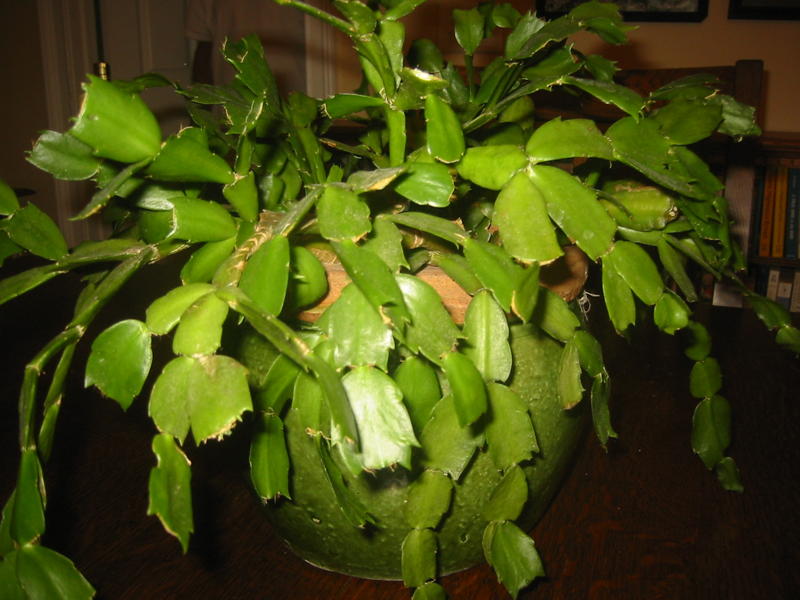
A dusty, wretched excuse for a houseplant, a scrawny, lopsided Christmas cactus sat on an end table in every house we lived in when I was a child. It never died, nor did it ever grow.  And certainly it never bloomed. I thought it was the ugliest plant I’d ever seen and wondered why my mother didn’t toss it. I suppose it was her depression-survivor thriftiness, like saving brown paper bags and aluminum foil.

I bought my own Christmas cactus when I had a home of my own and it didn’t fare much better.  I tend to forget to water and fertilize plants, so it’s no wonder. But I was on a mission: I was going to get my Christmas cactus to bloom.  I read everything I could find on the subject—because I tend to read up on things, rather than get things done.

And I tried most of the suggested systems, though fitfully.  Come autumn, I might stick the cactus in the closet for varying hours a day or put it under a cardboard box. The routines were complicated, and I invariably got them wrong. And nothing happened.  My Christmas cactus failed to bloom, or at best, I’d get one or two flowers that came and wilted far too quickly. I decided that blooming Christmas cacti were the province of horticulturists or the truly dedicated home gardener and not for the likes of me.

Then I visited an elderly couple on a farm in Pennsylvania.  And on the end table was the largest, healthiest Christmas cactus I’d ever seen.  It was covered with hundreds of deep pink flowers.  Maybe thousands.  It was drop-dead gorgeous. At that moment I longed once more to have my own Christmas cactus bloom.  I asked the woman’s secret.

“It’s easy,” she said.  Every spring, after the danger of frost is over, I set it outside in a protected spot.  I mostly ignore it all summer. Then come fall, before we have a killing frost, I bring it inside.”

That was it?  That was all there was to it?  It seemed too easy. I believed that life is always hard, and the more you want something, the harder it is and the more work you have to do.

But I tried her method the next year anyway.  I put my Christmas cactus outside in a shady spot near the house and did nothing else. In the early fall I noticed that it had many little buds soon to be flowers.  I brought it inside and sure enough, my Christmas cactus bloomed that year.  A quite respectable show, really.

Not at Christmas, mind you. I’ve never had my Christmas cactus bloom anywhere near Christmas.  But to ask for that is hubris. I need not challenge the province of the gods or horticulturists.

Since then, every year that I’ve followed those simple directions, my Christmas cactus has bloomed. And those beautiful drooping pink flowers cheer my soul.

No doubt there are many other ways to get Christmas cacti to bloom, all of them more complicated and scientific. No matter.  I found a system that works reliably for me—provided that I actually do it. And that is the catch, of course.  If I put it outside, if I find a spot out of the wind and bright sun, if I water it if we have a very long, dry spell, and if I bring it inside before a killing frost, my Christmas cactus will produce beautiful flowers for me.

It occurred to me that there were lessons for me to learn from this.  I tend to make life very complicated and very difficult.  How many challenging diets have I not quite followed to the letter? How many ingenious work schedules have I failed to observe?  How hard I make my life.  How quickly I don’t do what I need to, in my unnecessarily stress-creating schemes.  How many times have I bemoaned my feckless ways. My systems are often elegant—but usually doomed.

Life is never easy, true enough. But when I find and follow a simpler, less complicated path, I often bloom like the blossoms on my Christmas cactus.

I say this, and I’m getting better; but lessons come hard to me. A few weeks ago I went to sit with a Hospice patient, as I always do on Sunday mornings.  The husband had just brought in their huge Christmas cactus.  It had been sitting on their front steps all summer and was now covered with hundreds of buds. Magnificent. And, I remembered with a jolt, my own Christmas cactus was still sitting in a ceramic pot on my dining room table. I’d forgotten to put it outside. The summer and the first frost have come and gone. It’s too late for this year.

But I hope to remember next summer. After all,  I’ve found a simple plan that works, that has worked for me for years. All I have to do is follow it.  My Christmas cactus will bloom come November, next year.

May you and I bloom too.

Listen to the story here.

Maggie Smith / FreeDigitalPhotos.net

Copyright Margaret French

Photo of bloom by Maggie Smith.
(Maggie Smith / FreeDigitalPhotos.net)

Kids in the good old days (and other myths)

I’ve reached the age where my friends and I indulge in fantasies of the good old days. We had chores; our kids had chores; this was good.  I came across a passage in The American Frugal Housewife, by Lydia Maria Francis Child, published in 1832, that I wanted to share with you. (Why I read this stuff, I’ll never know.)

By the way, you may want to read this book yourself.  It has a recipe for Whortleberry Pie and hints for “How to Endure Poverty” that look too good to be missed. Here’s the passage.

In this country we are apt to let children romp away their existence until they get to be thirteen or fourteen. This is not well. It is not well for the purses and patience of parents, and it has a still worse effect on the morals and habits of the children. Begin early is the great maxim for everything in education. A child of six years old can be made useful; and should be taught to consider every day lost in which some little thing has not been done to  assist others.

Children can very early be taught to take care of their own clothes. They can knit garters, suspenders, and stockings; they can make patchwork and braid straw [for hats]; they can make mats for the table, and mats for the floor, they can weed the garden, and pick cranberries from the meadow, to be carried to market.

Provided brothers and sisters go together and are not allowed to go with bad children, it is a great deal better for the boys and girls on a farm to be picking blackberries at six cents a quart, than to be wearing out their clothes in useless play. They enjoy themselves just as well, and they are earning something to buy clothes, at the same time they are tearing them.

Comment if you like.  I’d love to read your thoughts.

(Now before you leave this site,  check out my page on the Saratoga storytelling open mic.  On Monday, November 8th, Jane Ainslie is our featured teller.  She is too good to miss!)

Jean Plante and the Loup Garou (Werewolf)

My Halloween gift to you: the scariest story I tell.  It’s an old French-Canadian tale that I translated & made work for me. When I tell it,  I always make it shorter–it’s way too long for telling–or a blog. I hope you enjoy it anyway.

(Wenceles-Eugene Dick, 1895)

Like many others, more than you know, I am not from this place, upstate New York, but from Canada. We come, bringing our families, belongings, stories–and secrets. After all, the way is easy enough on the highways or rivers and lakes that connect us. Almost anyone–or anything–could make the journey. And if I were you, I’d worry about our coming, just a little.

I want to tell you an old story from French Canada called “Jean Plante and the Loup-Garou.” The Québécois have had reason to fear the loups-garous for three hundred years and more. If a man isn’t a good Catholic; if, for example, he fails to observe Easter for seven years in a row, he may be turned into a loup-garou, a werewolf. By day he goes about his business, no one the wiser. But at night, every night, he becomes a huge wolf-like creature with eyes that blaze like hellfire, doomed to run with the other loups-garous unless someone, somehow cuts him and draws blood.  And who would even try? After all, the fangs of the loups-garous could easily, painfully tear a person to pieces.

I heard this tale one chilly fall evening in a tavern in Saint Francis on the island of Orléans, also called the island of sorcerers. At first I was disinclined to believe the stories being told that night. Perhaps my skepticism showed on my face as my husband and I nursed our drinks in a dim corner. For the storyteller spoke directly to me:

Don’t be so suspicious, Madame. Your doubts may come back to bite you. After all, these supernatural happenings are the ways le bon Dieu chastises his errant followers… the poor souls. Who are you to question the methods of the good Lord? What a pity if you were to suffer the fate of the wretched Jean Plante of Argentenay. He also doubted. Not that I am necessarily making comparisons.

Jean Plante was a little like our friend here. He didn’t believe in werewolves; he laughed at ghost stories and mocked the people who told them. Whenever the subject came up, he sniggered and said, “if monsters that go bump in the night should come my way, I’ll make short work of them.”

Well, it was a foolish way to talk. And indecent for a good Christian who respects the secrets of the good Lord. Not that I’m saying the same to you, Madame. I’m just saying it in a general sense.”

Jean Plante was thirty when this all happened. He was strong and fearless. You’d have a hard time finding his equal on the island of Orleans. He operated a mill on the banks of the Argentenay River, more than half a mile from his nearest neighbor. During the day, he worked in the mill with his younger brother Thomas. But at night, his brother left, and he slept alone on the second floor of the mill.

If he drank too much, he’d get angry if anyone looked at him sideways and he drank too much six days out of seven. When he was drunk, everyone kept out of his way. He had a big scythe hanging near his bed and you wouldn’t want him to come after you with that.”

One afternoon Jean Plante was working in the mill—and drinking too– when a quêteux, a beggar, came asking for charity for the love of God.

“Charity, you old lazy beggar! Look here, I’ll show you charity!” And he ran at him and gave him a swift kick in the backside.

The quêteux picked himself up and brushed himself off, but said nothing. He just looked at Jean thoughtfully and walked instead to Thomas who had just finished unloading a wagon full of oats.”

Charity, for the love of God,’ he said politely to Thomas, holding his worn cap in his hands.

But Thomas was busy, whipping his oxen, trying to get them to move. He spoke even more harshly than his brother. He cursed the beggar viciously and raised his whip as if he would hit him. As before, the quêteux said nothing. But he put a withered hand on the side of the mill, then slowly walked back into the dark spruce forest.

The quêteux was scarcely gone, when CRICK, CRACK, the mill wheel abruptly stopped turning. Jean cursed and went to see what had happened. He thoroughly checked the big wheel, the gears, everything. Everything seemed in order. But nevertheless no water flowed,

He called to his brother, “Hey Thomas!’

“What do you want?’

“’The mill has stopped.’”

“’I can see that for myself.’”

“’What happened?’”

“’How would I know? It’s your mill.’”

“’I think you do know. You must have done something. You probably dumped in oats that were full of stones.’”

“There are no stones in those oats. Don’t you think I would have noticed?”

“’Maybe your eyesight isn’t what it should be today. Or your good sense.’”

“Take a look for yourself,” said Thomas. And under the blazing eyes of his older brother, he began to empty the huge funnel where he’d dumped the oats, ready to be milled.”

“Jean searched through the oats but found nothing at all.”

“’This is bizarre,’” he muttered. “Everything is working fine. But the mill won’t go.’”

“Thomas suddenly slapped his forehead. ‘I know what happened,’ he said. ‘It was the old quêteux, the beggar. He put a curse on the mill because we turned him away.’”

“ ‘A curse? You fool! We don’t have time for superstitious nonsense. We have work to do.’ And he gave a second kick—this time to his brother.”

“Thomas flew into the air and landed on all fours. When he scrambled to his feet he was beside himself with fury. He flew at his brother. But Jean Plante could thrash a half-dozen men the size of his brother. He grabbed Thomas’ arms and held him tight.”

“’Don’t even think of it,’ he warned. ‘If you ever lay a hand on me, brother or no, you won’t live long enough to regret it.’”

“Thomas knew that he was not as strong as his brother. Trembling and crying from rage, he went to fetch his cap. Then he left, shaking a menacing fist at his brother.”

“When you see me again…when you see me again….”

Now Jean was alone. For the rest of the afternoon, he tried to fix the mill. The wheel turned once, and then Crack, it stopped altogether.

He did nothing because there was nothing he could think of to do. He didn’t know that it was the beginning of the end. He set his jug on the table and began to drink. By midnight he was as drunk as a skunk.

“He wanted to go to sleep. Easy enough on most nights. But on that particular night, his feet didn’t operate properly. He bumped into the furniture and kept taking wrong turns on the short walk to his bed. Finally he got angry.”

“’It must be right about here,’ he thought. ‘If my feet won’t carry me there, I’ll just throw myself in the direction of the bed.’”

“He leapt forward, his arms stretched out. But it wasn’t his wretched bed that he landed on, but the opening to the stairwell. He rolled limply, awkwardly down the stairs and found himself outside, under the stars. To get back upstairs, in his condition? Impossible. He must sleep on the hard earth all night.”

“Even though he was drunk, Jean couldn’t fall asleep. For hours, he counted stars and watched clouds pass in front of the moon. Around two o’clock in the morning, a powerful wind blew from the north, engulfing the stairwell, and blowing out the candle he’d left burning in his upstairs room.

He found it amusing.

“Monsieur Wind. Merci beaucoup.  How kind of you to blow up the stairs and blow out my candle. You keep house better than me.”

He began to laugh, but not for long. A few minutes later, the candle light reappeared and went from window to window as if carried by an invisible hand. At the same time, from inside the mill came the sound of chains, of groans, of stifled cries and whispers, terrifying enough to make your hair stand on end, to make you believe that all the devils of hell were celebrating Black Sabbath inside.

Just when this commotion had died down, a new terror began. Scattered flames, green, blue, and red danced on the roof and jumped from one gable to the other. They even brushed against the poor drunk lying on the ground, scorching his beard and hair a little.

Finally, a huge dog, at least three feet high came out of the forest and stopped in front of the miller, gazing at him with red eyes that burned like charcoal.

Jean shivered, maybe from cold. He tried again and again to get up, to get back to his house. But terror paralyzed him as much as the drink and he couldn’t move until morning, though by then all the events of the night had ceased.”

With the light of the sun, his courage returned and he made fun of the things he had seen. Bad rum had caused bad dreams. Still, he felt an uneasiness which he overcame by tossing down a few more drinks. Soon he was as drunk as the night before. Defiantly he dared all the spirits and the loups-garous of the island to come back and try to frighten him.”

All day long he tried, unsuccessfully, to fix the mill.

When evening approached, Jean was apprehensive. It was all well and good to say that he had dreamed the events of the night before, but he couldn’t quiet his mind. He should have gone to the village to be near other people, but he couldn’t bring himself to tell anyone. He couldn’t stand the thought of people laughing at him. Instead he chose, bravely, to sleep again in the mill. But just in case, he carefully locked all the doors and windows.

All went well, until midnight. Jean began to think he might have a peaceful night, that the events of the night before were only in his imagination. But BONG, BONG…the clock began to strike twelve. The uproar began again. POW. The sound of a fist. BOOM. A heavy footstep. Groans again. The clank of chains. Some bursts of laughter. Whispers. Some blasts of cold air. Pandemonium. Enough to make lesser men die of fright.”

Instead Jean Plante turned white angry. He grabbed his huge scythe from its place on the wall and searched the whole mill from the attic to the ground floor and outside too. He noticed something curious. When he went to the place where he heard a sound, it stopped, and started up in the place he had just left. It was enough to make a man mad.

He gave up, went back to his bed and pulled his blankets over his heed. Still he shook the rest of the night.

The same thing happened every night for the next week. On the evening of the eighth day, the evening of All Saint’s Day, Jean was alone as usual. He hadn’t gone to mass since all of this had begun. He claimed that he was sick. Really he preferred to drink his worries away and to defy the good Lord—if truly it was He who had sent these troubles. Poor Jean Plante was not the man of a week before. His face was puffy and his eyes burned with fever.

“Outside a fierce north-east wind blew all night long, pelting the windows with rain. The night was as black as hell. Jean sat at his table, gazing stupidly at the jug in front of him. Drops of tallow dripped from his candle.”

Suddenly the clock struck eleven. Jean counted and trembled. He wanted to get up, but pride held him in his chair.

“I will not get up. I will not run away. Not me. No.  I am afraid of nothing.”

He poured himself another drink. Midnight arrived. BONG. BONG. Jean’s eyes opened wide.  On the final strike of twelve, a violent gust of wind blew the door open. There, at the top of the stairs, sat the huge dog of the previous nights. He sat on his haunches, eying Jean. For a good five minutes, the miller and the dog stared at each other; the one terrified, the other calm but menacing.

At last Jean could take it no longer. He got up to grab the candlestick so he could see better. The candle went out. He quickly searched for the packet of matches which had to be on the table—womewhere. But he couldn’t find them.

Now he was truly terrified and began to back up in the direction of his bed, always facing the beast, which slowly began to pace the length of the bedroom. He heard the monstrous dog draw closer to him step by step.

ts eyes were bright as fire and it kept them on Jean Plante.

When the dog was not more than three steps from him, the poor man lost his head and grabbed his scythe.

It is a werewolf!” he cried in a strangled voice. And he brought back his powerful arms and struck at the animal furiously

In that instant, his world turned upside down. With a roar like thunder, the mill wheel began to turn. His room filled with light. Thomas Plante stood in front of his brother with a lit match in his hand. The massive dog had disappeared.

Silently Thomas relit the candle. He said to his brother, who still clutched his scythe,

“What the devil are you doing in the darkness? Have you gone mad”

Jean was speechless. He looked at Thomas, who was missing the end of his right ear.

“Who did that to your ear?” he said, in a voice no louder than a whisper.

“You know already,” Thomas said harshly.

Jean threw the scythe down to embrace his brother. Then, from the floor of his room, he stooped to pick up the still-bloody ear of a dog. He looked first at it and then at his brother.

“It was you, then,” he whispered.’ He laughed but no sound came out.

Those were the last coherent words he spoke. Jean Plante was insane.”

The storyteller knocked the ashes out of his pipe to indicate that his story was done. He laid his pipe on the mantel and glanced at me, that cold fall evening, on the island of Orleans, also called the island of sorcerers, as if to see if I had grasped the folly of my doubts. Near the mantel, hanging from a nail on the wall, I spied a gruesome relic: the dried brown ear of what appeared to be some animal, perhaps a dog…or a wolf.

Of course that was years ago. You may believe that all the dreadful creatures of the night have long since died off. But can you be so sure? Has human nature changed one iota from that day to this? Perhaps le bon Dieu is still chastising his people, poor souls? If I were you, I’d worry a little about the creatures who might make the easy journey from Quebec to Saratoga. And whatever your faith, it’s probably a good idea to observe your religious customs with a pure and earnest heart.

© Margaret French

The Toy Cash Register

Intro: It’s only October, but my husband and I just gave each other our Christmas presents–Kindles.  We’re planning to take them on an upcoming trip. I’m reminded of a story about a gift I dearly wanted as a kid and a lesson I learned with exceeding slowness.

Every year at Christmas time when I was a child, I’d pore page by page through the Christmas catalogs to decide exactly what I wanted.  For years it was the same thing: I wanted a toy cash register made of red metal.  If I pressed the levers down, the numbers would pop up and the drawer would slide open.  If I ever got any money, that is where I planned to put it.

Year after year, I got other presents: a china bank in the shape of a Canadian paper dollar (in the days before dollar “loonie”coins), a tea set in bright colors, a zippered manicure kit in a blue leather case, pyjamas (now that was a major disappointment).

I always got a stocking to be sure: a Red Delicious apple, an orange, maybe even a pomegranate.  Nuts, chocolates, ribbon candy, a bottle of pink fingernail polish.

But no cash register!  What was the matter with Santa Claus?  What was the matter with my parents and the world in general?  How sad was it that I, a goodie-two-shoes little kid, who never gave them a bit of trouble, couldn’t get the one  present I longed for with all my heart?

I was in my thirties when I figured it out.  Just maybe I had never gotten a toy cash register because I’d never told anyone that I wanted one. How were my parents supposed to guess that a cash register was my heart’s desire?  I had assumed that if my parents truly loved me they would “know” what I wanted.  I also believed, as a child and as an adult, too, that it would hurt too much to ask for something and maybe not get it.

I was approaching fifty when I shared the cash register story over coffee with a few women friends. We talked a bit about how hard it is-often–to ask for what we want and need.  Self-reliance is admirable, but being able to be open enough to let others know our wants and needs can be a good thing too. As I recall, they told me that I was an idiot and it was a wonder I had survived in this world as long as I had.

For my fiftieth birthday, two of those women gave me birthday presents: one Fisher-Price cash register and one Sesame Street cash register. I kept them both for years as a reminder of the real gift I received from them that birthday, the lesson that sometimes in life, if you make your wishes known, you can get what you want. Eventually I passed the toys on to grandchildren. I kept the lesson though.

Oh yes, I learned something else along the way. If I ask but don’t get—I can easily survive that too.

PS I added a page–on the list of pages above–to keep you updated about the Saratoga storytelling open mic. It’s got our schedule for the year.  Check it out.  For more storytelling events in our area, go to StoryCircle of the Capital District.  The link is also on my blogroll on the right.

Locked Into Teaching

Intro: At our last open mic at Caffe Lena, I told “Locked Into Teaching.”  Can you imagine me as a nervous, prissy English teacher teaching Hamlet and poetry in a maximum security prison for men?  I hope so.  The story is mostly true. (I didn’t really teach Wordsworth’s poem about daffodils.)

I did it for the money, $1,500 for six weeks.  (And to broaden my horizons and serve humanity.) Beatrice, my office mate at the college, had taught there for  years, and she is probably no braver than I.  Surely I too could teach a summer course at the nearby maximum security prison for men.

Before I taught my first class, the prison authorities had to put  me in their system. Getting  fingerprinted was fascinating, but a little messy. I got a little ink on my shirt that won’t come off.  I suppose my fingerprints are now in some national data bank.  If I should ever do anything illegal, I’ll be caught in hours, and my family humiliated.  So I am really careful.

The correction officer took my picture and made two ID cards, one for me to carry with me inside the prison, one for their files–so they would know what I looked like if I never made it back from class.  He reminded me to  lock my car–always–before I came into the prison.  (Who wouldn’t?!)

On my first day of class, the officer compared my face to the one on my ID and waited while I locked my watch and purse in a  locker.  He checked my textbooks, attendance book, notes, handouts, pens, Kleenex, and emergency chalk. He sent  me through a metal detector, then set me free to enter the prison—or rather go through the first of three sets of heavy sliding metal bars.

The bars behind me slid shut and locked before the bars ahead of me began to open.  For  a little while I was  trapped between them. If there were a prison riot, I would be safe, I guess, sort of, locked between the bars. After the third set of bars, there I was, at one end of a very, very, very long hallway. You would expect a correction officer to walk with me to keep me safe. But no.  I had to walk to my classroom alone—with hundreds of rapists and murderers and other criminals deserving to be sent to a maximum security prison all around. And the guards were god knows where.

I considered the advice that my colleagues at the college, had given me:

Roy had said, “You’ve got to keep discipline, or they won’t do any work for you.”  I don’t think he had high hopes for me. He added: “You’re too friggin’ soft.”

Beatrice warned:  “Dress conservatively.”  So I wore my usual: white blouse, longish navy skirt, sensible shoes, one heel a little wobbly, but who really notices?

I stopped to get talked to by the education officer. “Whatever you do, don’t criticize the men in class.  They won’t tolerate being put down in front of their peers.  Woman or not, they’ll take you out. If you have problems, call out; I’m  just down the hall.”

Not in the classroom, somewhere down the hall. I haven’t screamed in any serious way in my entire life, so I earnestly hoped that nothing went wrong. It was almost time for class. I adjusted my pile of books and papers a little, put my head down and scurried towards the classroom, preoccupied, wondering how I was supposed to keep discipline at all costs while never criticizing anybody.  The door was open.  I noticed the rows of men at metal desks waiting for me, but not the step up into the room.

My  wobbly heel caught on the sill, and I was flat on my face on the floor–books, papers,  pens, and emergency chalk scattered around my outstretched arms and legs. Silence.  I kept my eyes down, picked up my stuff, dumped it on the battered metal teacher’s desk and sat down. More silence.  I looked up at twenty-five silent big men.  Most had huge necks, chests, biceps, the product of life sentences to lift weights.  They didn’t smile or move; they looked at me and waited.

“Good morning.” My voice was squeakier than usual. “Today we begin Introduction to Literature.  We’ll be studying poetry, short stories, and Hamlet.”  And I stumbled through my first class.

Weeks passed.  They did the reading and spoke up in class, unlike most of my students at the college. We read parts of Hamlet out loud.  I got to be both Ophelia and Gertrude.  They said I wasn’t bad.  I got permission to loan them a videotape of the play,  and they watched it at night, which, they said, made it easier to learn.  But they still didn’t much like Shakespeare and said so, often. I didn’t criticize anyone in class, and no one beat me up.

I had one “incident.” Tony made fun of another student for  asking too many dumb questions.  George, a gigantic man with biceps bigger than my waist, rose to his feet and bellowed, “Who are you, *?*#!?! , to tell him he can’t talk in class?” And he nodded towards the door.  They left abruptly, Tony first, George following. “I’ll never see little Tony again,” I thought.

Probably I should have done something.  But I didn’t have a clue what that something was.  So I finished teaching the poem “I wandered lonely as a cloud.”  You know, the one by Wordsworth, about daffodils. After awhile, George came back alone.  I hoped Tony was alive and not badly hurt. The next day, Tony came back too.  Nobody explained anything to me. And I didn’t ask.

The men wrote papers, sometimes pretty good, except for the  plagiarism.  It was egregious!  I talked to Roy back at the college.

“Margaret,” Roy said.  “They’re in prison for reasons more serious than plagiarism.”

On the last day of class, we finished early.  The men and I were almost comfortable together by then.   They wanted to chat.

“Do you remember the time George took Tony out of class,” one asked. I nodded. “We were all watching your face.  If you had cried, none of us would have come back.” Several agreed.

“And do you remember the first day of class? The day you fell on your face?” I doubted that I could ever forget. “We all thought it was the funniest thing we’d ever seen. The education officer came to talk to us afterwards.

“Men, I don’t care how bad a teacher she is.  You had no business throwing her on the floor like that.’”

Everyone but me laughed. Class ended. We said our good-byes.  One student offered to carry my books down the long hallway.

At the entrance, another inmate, a man I’d never noticed before, approached me and offered to carry the books to my car. (I really don’t think it’s allowed.)

“It’s the red Dodge Colt,” he said. “I watch you every time you leave.”

And with this unsettling tidbit in mind, I walked alone from the prison to my rusty little red car, on the last day of my prison teaching career.

Copyright by Margaret French